
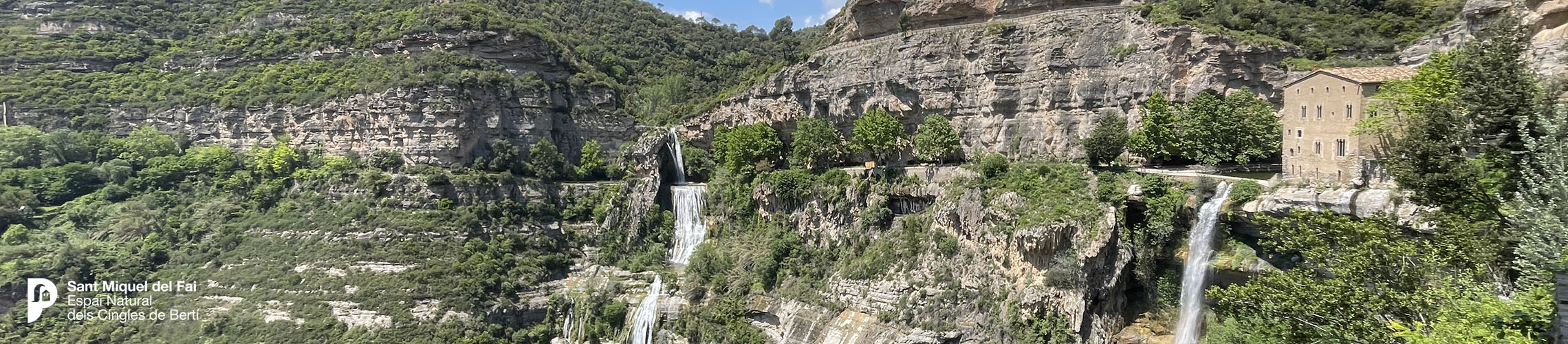
Casa Prioral
Located on L’Abadia square, the priory housed the prior and the quarters in which a community of Benedictine monks lived. It consists of a Gothic-style manor house, with a more or less square structure and a gable roof. The building has not undergone any major alterations throughout history and is considered to have been built between the late 16th and early 17th centuries.
It is worth noting that the construction was initially believed to date from the 15th century, following the publications of Antoni Pladevall (1991), although this is still debated. Different architectural and situational features lead us to formulate the hypothesis that construction would have begun during the priory of Jaume d’Agullana in the late 16th century and finished during the mandate of his successor, Bernat de Cardona, in the first third of the 17th century. Evidence that gives strength to this hypothesis is the Pia Almoina building in Girona, currently the College of Architects, which was significantly altered during the archdeaconry of Agullana. The façade of the Pia Almoina bears a strong resemblance to the priory. For example, the arched windows, that is, windows divided into two or three openings separated by columns, have the same structure and design as those in Sant Miquel del Fai. This leads us to believe that Jaume d’Agullana could have been inspired by this building when planning the Sant Miquel manor house or was even responsible for the repairs in both buildings simultaneously.
The current two-story rectangular structure attached to the north and west sides has not been accurately dated. It is believed to have been added between the 17th and 18th centuries. This attached building initially had a single slope roof.
With respect to the house’s uses, thanks to a notarial inventory in 1717, a large amount of information is available to us on the functions of it’s various rooms. Starting at the bottom and going upwards, there would first have been the semi-basement, including a room for the servants, a small cellar and the stable for the animals. Above, on the ground floor, there was the kitchen, located in the middle in order to heat the entire house. Around the kitchen was the dining room, the entrance hall, including the staircase up to the first floor, and a series of rooms that were used as storage and work areas. One of these rooms, known as ‘the woodshed’, was accessible from the kitchen and was used as a bedroom. In the woodshed, the coffered ceiling has been preserved, with decoration consisting of painted thistle flowers, maintaining a great resemblance to the paintings in the Molí de Blancafort chapel in La Garriga, from 1674. The staircase up to the first floor from the main entrance was admired by many architects from the time during the visit that Víctor Balaguer paid to Sant Miquel del Fai. The reason for this was the lack of a buttress at the top of the staircase, which led many to demand that it be disassembled to find out how it had been built. It currently has three cantilevered beams that were installed in order to reinforce the stairway vault.
Above, the first floor was divided into four rooms. On one side of the hall were two of them as well as the latrine, which emptied directly out of the building on the west side. One of the rooms was the prior’s room, reserved for when the archdeacons of Girona visited Sant Miquel del Fai. On the opposite side of the hall were two more rooms, of which only one remains due to the dividing wall having been demolished. One of these, the south-easterly facing room, was called ‘the painted room’, most likely because of some artistic decoration that no longer exists. In this room slept the priest of Sant Miquel del Fai and the priory’s archives were also housed within it. The other room, now merged with the painted room, was used to accommodate those who asked to spend the night at the priory. It is believed that the top floor of the priory consisted of an attic, although we have no information about its purpose, as it is not mentioned in the notarial inventory of 1717.
The history of the priory of Sant Miquel del Fai ends in 1841, with the disentailment spearheaded by General Espartero. It was then that the priory became state property. This led to the suppression of worship in the churches of Sant Miquel del Fai, while the priory was converted to provide lodging and as a restaurant for visitors.
Audio descripcion
Audio guide