
Educational visits
Sant Miquel del Fai, as an open classroom, has a long tradition of environmental education. The educational visits offered here feature activities guided by educational staff for school groups, training centres and third-sector and open-education organisations. They last approximately 2 hours.
Educational visits can be made from Monday to Friday between 10 am and 2 pm during the months when the space is open. They can be booked for a maximum of 60 people.
The booking must be made using this form:
Summary of the educational project (PDF) | View the full document (PDF)
Available activities adhere to the LOMLOE Spanish educational curriculum and include adapted and interpretive-guided activities.
If you want to come and visit Sant Miquel del Fai unescorted, you can make a group booking at this link.
The geological, biological, ecological, landscape and heritage characteristics of Sant Miquel del Fai are very important and unique. The educational objectives of the space strive to foster attitudes of respect and commitment to responsible enjoyment while at the same time providing the necessary information, in an attractive format, suitable for the diversity of society as a whole, so that everyone understands and interprets the natural heritage of Sant Miquel del Fai and can enjoy a special, unique experience.
The main pedagogical objectives are to teach people about the history and characteristics of the heritage of Sant Miquel del Fai, to recognise the main elements of the landscape and the geological processes that gave rise to them, to identify the animal and plant species of rock shelters, cliff faces and underground filtrations, and their adaptations to the environment, as well as to raise public awareness of the changes in the landscape caused by recurring floods and droughts, accentuated by the context of the climate change crisis.
Furthermore, it strives to foster respectful relationships with Sant Miquel del Fai in particular and with the natural environment in general, comply with the regulations and measures that apply to the space, understood as being of utmost importance with a view to guaranteeing the conservation thereof, raise visitors’ awareness of the risk of forest fires that threaten the area, while highlighting the Bertí Cliffs as a natural space that strengthens the connection of the protected spaces of the Catalan Pre-Coastal mountain range.
The educational importance of Sant Miquel del Fai and the area that is currently open to visitors (from La Foradada Passage to the Tenes Waterfall) hinges on several areas of interest: history, the natural environment (geology and biodiversity) and the landscape. It is also a space whose use is governed by regulations contained within a declared area of natural interest, such as the Bertí Cliffs, the Catalan Pre-Coastal mountain range and the contact line of the counties of Vallès Oriental and Moianès.
Sant Miquel del Fai has undoubted historical value, reflected in its many architectural features, such as the Gothic-style Priory House, the Romanesque Sant Miquel Church, the Rossinyol Bridge, which dates back to 1592, not to mention the 16th century fortified gateway. Among its most interesting natural heritage features, we would highlight the bird life of the rupicole (rocky) environments, the habitat of calcareous dripstones with muscicolous communities (a group of mosses that colonise surfaces such as rocks, soil, tree trunks or walls, especially in humid and shady environments) and pteridophytes (vascular plants that reproduce by spores) that form there, the cormophytes (plants with well-differentiated organs, root, stem and leaves, which can reproduce by spores or seeds) that take root in cliff fissures, and the communities of chiropterans (bats) that take shelter in the caves there.
Geology
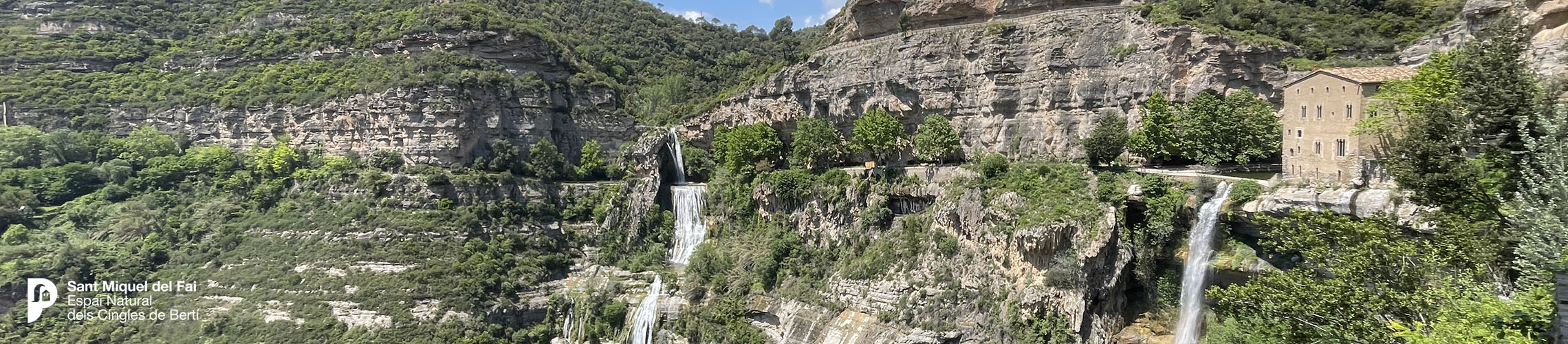
The geological shaping of Sant Miquel del Fai provides other items of interest, such as the processes of formation of gorges, pools and caves, and the emergence of multiple speleothems by precipitation of calcium carbonate, a process also accelerated by the physical medium of mosses and ferns, which, in turn, contribute to forming the landscape. The formation of soft limestone and the sedimentary rock strata of the cliffs (sandstones, limestones, conglomerates) are other geological aspects of interest in Sant Miquel del Fai.
The area’s geology, shaped by local hydrology with the course of the Rossinyol and Tenes rivers, covered by the vegetation of scrub and pine forests, and transformed by intentional or accidental anthropic action (human occupation of Sant Martí with the historical elements mentioned above, former farmlands in the Tenes valley, forest fires in 1994 and current recurring droughts aggravated by climate change) make up, as a whole, a spectacular landscape that lends itself to reading and interpretation.
Sustainable public use
Finally, space management measures aimed at guaranteeing the sustainability of its public use are a new thematic vector that must be given prominence, since any environmental education initiative, such as this project, seeks to ensure that learning and discovery encourage people to appreciate and respect the environment. Environmental education socialises knowledge and experiences to promote sustainability of human societies.
With this educational resource, we aim to provide activities that enable children and young people to explore Sant Miquel del Fai and its surrounding environment in the broadest and most enriching way possible, with activities formally tailored to each level of learning and whose performance is suited to each curricular level.
It is worth noting that, although in all the activities we address the landscape, history, fauna and flora, and the importance of sustainable management of the space, the way these activities are carried out, the material resources used to reinforce them and the concepts explained vary according to the children’s educational levels and needs. In the formal approach to the activities, there is one element they all have in common: to get away from a chalk and talk approach and instead aim to use stimulating, intriguing and exciting resources and tasks that call for students’ active participation and that are often fun, so that the activity becomes unforgettable as a resource so what they are learning is internalised more. Across the board, the activities have a common theme: conveying the need to respect the natural environment and, consequently, how its use is regulated (a point that is especially important in a space such as Sant Miquel del Fai that tourists have always flocked to in droves). Finally, based on the development of the thematic axes in the activities, we have gone to great lengths to guarantee an inclusive approach to the activities proposed and the materials used, with discovery learning tasks that appeal to various senses.
Broadly speaking, the 2030 Agenda for Sustainable Development (SDGs) set by the United Nations General Assembly strive to eradicate poverty, fight against inequality and injustice and halt climate change.
With the Sant Miquel del Fai educational project, the space does its bit to contribute to achieving a number of SDGs. In particular, it relates to Sustainable Development Goals (SDGs) #4 (Ensure inclusive, equitable and quality education and promote lifelong learning opportunities for all), #6 (Ensure availability and sustainable management of water and sanitation for all) and #15 (Protect, restore and promote sustainable use of terrestrial ecosystems, sustainably manage forests, combat desertification, halt and reverse land degradation, and halt biodiversity loss).
Goal 4. Ensure inclusive and equitable quality education and promote lifelong learning opportunities for all
Among other objectives, SDG 4 sets out to:
- Foster education programmes for sustainability in non-formal education (socio-educational, occupational, cultural and leisure areas) and informal education (media, community action, etc.).
- Foster co-education in order to gradually erase the transmission of traditional genders and replace them with a diverse culture that opens up all the possibilities of doing and being to everyone.
Goal 6. Ensure availability and sustainable management of water and sanitation for all
Among others, SDG 6 aims to:
- Conduct an in-depth, open and transparent reflection on the possible existing alternatives to guarantee the supply of water resources for Catalonia.
- Guarantee the correct functioning of ecosystems in relation to the water cycle, ensuring the maintenance of sufficient ecological flow in the rivers of Catalonia
- Fully integrate ecosystem criteria into water resource management.
Goal 15. Protect, restore and promote sustainable use of terrestrial ecosystems, sustainably manage forests, combat desertification, and halt and reverse land degradation, and halt biodiversity loss
Among other objectives, SDG 15 aims to:
- Foster the conservation and improvement of the town's natural heritage and prevent the loss of species and habitats.
- Set up facilities to renaturalise urban spaces to create climate shelters, to promote biodiversity (nest boxes, insect hotels, naturalised ponds, etc.).
- Increase knowledge of parks and other municipal green spaces through botanical pathways, educational proposals, guides, etc.
- Identify species that require special support and take action to protect them.
Sant Miquel del Fai
Espai Natural dels Cingles de Bertí
BV-1485, km 7
08416 Bigues i Riells del Fai
Tel. 666 541 593 - Informació i gestió de reserves
santmiqueldelfai@diba.cat
smf.activitats@diba.cat (només per a visites de centres educatius i de formació)
ATENCIÓ: L'horari d'atenció telefònica i de la bústia de correu electrònic és de dilluns a divendres de 10 a 16.30 h.
