
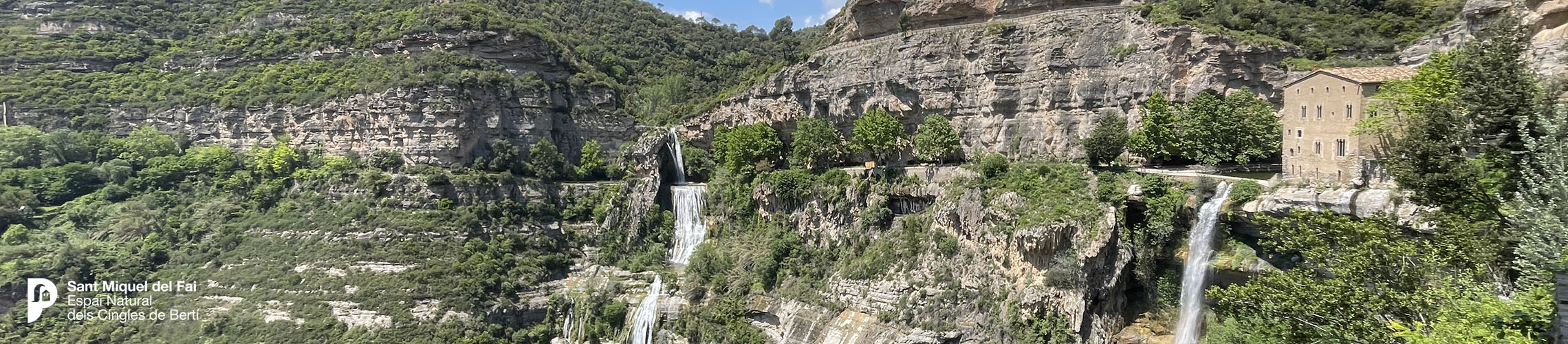
Sant Miquel cave
Sant Miquel cave, also known as the ‘dark cave’ or the ‘dragon cave’, was discovered in 1836 and consists of a single gallery running in a north-east/south-west direction, parallel to the cliffs. It has practically no slope and a total length of roughly 50 to 60 metres. The cave is formed from calcareous tufa, produced by calcium carbonate precipitated out of ambient-temperature water that often contains micro-organisms. It has often been used erroneously and as a synonym of the term travertine, which refers to carbonates that precipitate in hot hydrothermal waters that usually do not contain micro-organisms.
Within the calcareous tufa deposits in the Tenes valley, two types of caves have developed: caves formed within tuffaceous masses and caves formed from caverns. The former are a consequence of the irregular growth of tufas and their high porosity, which allows cavities to form within them. As tufas are rocks that can be cut easily, such cavities are often expanded by human activity and, in them, galleries and rooms have been excavated in order to create spaces for various uses.
A second type of cave is formed as a result of the growth of a tufa curtain right in front of a cavern. The cave of Sant Miquel is a good example of this. In this cave, the tufa has ended up covering the entire cave. It consists of tufa growths that expand vertically in the direction of gravity, forming walls that eventually isolate the caverns from the outside, leaving behind a cave. Once the cave is shut off from the outside, a karst environment develops, forming stalagmites and stalactites that cover the inside of the walls.
The cave has no archaeological potential, since it has been completely modified with modern structures and infrastructures so that it can be visited by the public, although it is of great educational interest due to current geological processes concerning the formation of calcareous tufa.
One of the most interesting zoological groups to inhabit Sant Miquel del Fai cave are bats. Species living in the cave include the most vulnerable, mainly cave-dwelling species, such as the common bent-wing bat (Miniopterus schreibersii), found in Sant Miquel cave, the three horseshoe bats (the greater, Rhinolophus ferrumequinum; the Mediterranean, R. euryale, and the lesser, R. hipposideros) and some species of myotis bats, such as the greater mouse-eared bat (Myotis myotis), the long-fingered bat (M. capaccinii), the Daubenton’s bat (M. daubentonii) and the Geoffroy’s bat (M. emarginatus). These strictly cave-dwelling bats provide us with information about possible colonies inhabiting other caves and caverns in the natural area of Sant Miquel del Fai. Identification of the Mediterranean horseshoe bat (Rhinolophus euryale) is particularly important, as few potential roost sites are known for this species, currently one of the most endangered.
Audio descripcion
Audio guide